 BreizhVoIP
Voicemail
Take the message when nobody can answer, and get it to the right person. The caller hears your greeting, leaves a message, and it arrives by email with the recording attached and a written transcript. You read before you listen, call back without playing it all again, and nothing gets lost between the answering machine and whoever was meant to ring back.
How it works
The caller hears your greeting, the one you recorded or had spoken by a synthetic voice.
They leave their message, within the time limit you set.
The message goes out by email with the recording attached, to one address or several.
The text of the message travels with the audio: the transcript reads at a glance, even in a meeting.
The message stays available in the softphone and in the admin screen.
Each message keeps the caller's number and the time, which is enough to call back without listening again.
A mailbox can be personal or shared by a department, depending on who handles the messages.
Use cases
- Personal mailbox: everyone gets their messages by email, including on the road.
- Company answering machine out of hours, with opening times and the address in the greeting.
- Shared department mailbox, sales or support, where the first person free handles the message.
- Exceptional closure: a dated greeting, and the messages that still come in are read the next day.
- Night duty: the message goes by email to the person on call, with the number to ring back.
- Extended absence: messages are sent on to a colleague rather than piling up.
What you configure
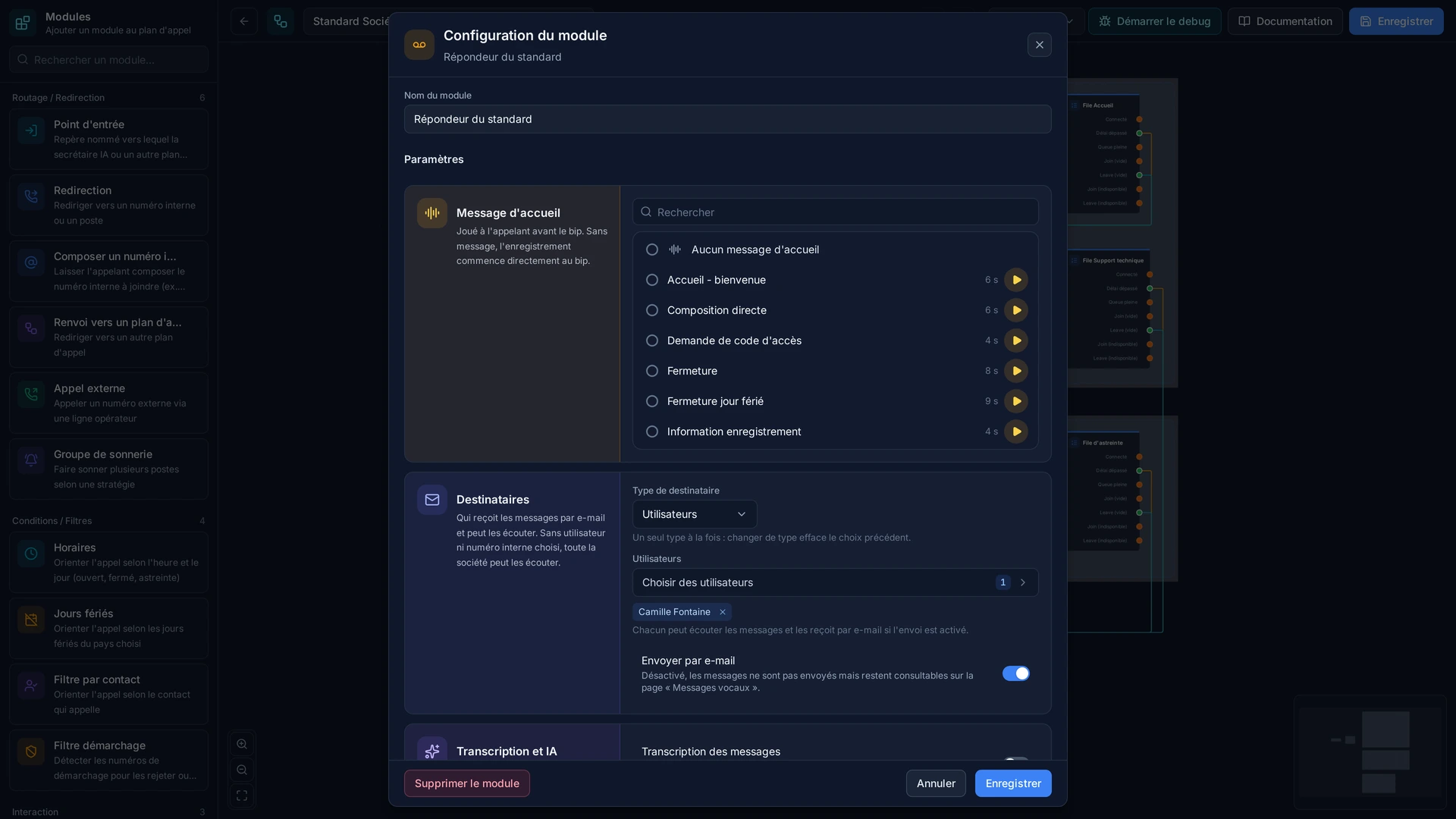
- Maximum length
- How long a message may run, in seconds: 60, for instance. Recording stops on its own past that point.
- Email delivery
- Sends every voice message out by email. The recording is converted to MP3 and attached, so messages land in a mailbox rather than waiting on the phone system.
Examples
- Out of hours: 'we are open Monday to Friday, 9am to 6pm', the message arrives by email with its transcript, and the caller is rung back at opening.
- Shared sales mailbox: three people receive the same message, the first one free calls back.
- Annual closure: a dated greeting for two weeks, with messages collected once a day.
- A director's extension: messages transcribed and read between meetings, call-backs grouped at the end of the day.
In the panel
Read the guide: Recevoir les messages vocaux par email, avec transcription
Modules in the same category
Audio Message
Play a message to the caller: the greeting, a piece of information, an instruction, a one-off announcement. The files come from the audio studio, where they are recorded from a microphone or spoken by a synthetic voice, and they change in minutes. It is the most used module in a phone system, and the one that sets the tone of the company before anyone picks up.
Hang Up
End the call deliberately, at a chosen point in the flow. A phone system that never hangs up leaves the caller in silence wondering whether anyone is coming. After a closing message, after an error announcement, or when every line is taken, it is better to hang up clearly and, if needed, tell the caller's operator why.
Wait / Pause
Insert a silence or a pause in the flow. Two messages running into each other are hard to follow, and an announcement that starts before the caller has the phone to their ear is not heard. A second or two is often what separates a pleasant phone system from an abrupt one.