 BreizhVoIP
Call queues
Enterprise-grade call queuing with 7 distribution strategies, real-time agent management (login/logout, pause, skills), live supervision dashboard, SLA metrics, position announcements, callback options and comprehensive historical statistics.
How it works
Create queues and choose from 7 distribution strategies: ringall (all agents ring simultaneously), leastrecent (agent who received a call least recently), fewestcalls (agent with fewest completed calls), random (random agent selection), rrmemory (round-robin with memory of last agent), linear (fixed order), wrandom (weighted random based on agent priority)
Add agents as queue members with individual skills, priority levels and penalty weights for fine-grained routing
Agents log in and out of queues dynamically, from the web panel, mobile app or physical phone
Agents can pause themselves with a reason code (break, lunch, meeting, training) and resume when ready
Callers hear customizable hold music and periodic position announcements: their queue position and estimated wait time
SLA metrics track service level targets: percentage of calls answered within a defined threshold (e.g., 80% within 20 seconds)
Callback without losing their place: after the delay you choose, the caller can press 1, hang up, and an agent calls them back when their turn comes
Real-time supervision dashboard shows live queue depth, waiting callers, agent states, average wait times and SLA compliance
Timeout handling: if no agent answers within the configured time, the call follows the overflow route (voicemail, another queue, external number)
Full queue overflow management: maximum callers in queue, maximum wait time, and fallback routing for each scenario
Historical statistics provide detailed reports on call volumes, wait times, abandon rates, agent performance and SLA trends over any period
Use cases
- Customer support centers distributing calls fairly across agents with fewestcalls or round-robin strategy
- Technical help desks routing calls by agent skill level using weighted random distribution
- Sales teams using ringall so every rep has a chance to answer first
- After-hours support with callback option so customers do not wait on hold
- Multi-department organizations with separate queues per department and overflow between them
- Supervisors monitoring real-time dashboards to detect call spikes and adjust staffing instantly
- Quality assurance teams reviewing historical statistics to optimize SLA targets and agent schedules
- Seasonal businesses scaling agent pools dynamically with login/logout and pause/resume controls
Benefits
- 7 proven distribution strategies for any call routing scenario
- Dynamic agent management: login/logout, pause with reason codes, skills and priorities
- Live supervision dashboard with real-time queue depth, agent states and SLA compliance
- SLA metrics tracking with configurable thresholds and alerting
- Position and estimated wait time announcements to keep callers informed
- Callback option to eliminate hold time and improve customer satisfaction
- Comprehensive historical statistics: call volumes, abandon rates, agent performance, SLA trends
- Customizable hold music per queue with music-on-hold categories
- Overflow routing with configurable max callers, max wait time and fallback destinations
- Skills-based routing with weighted priorities for specialized teams
Configuration
- Strategy
- Select the call distribution strategy: ringall, leastrecent, fewestcalls, random, rrmemory, linear or wrandom.
- Members
- Add agent extensions as queue members. Set individual penalty (priority) and skills for each agent.
- Timeout
- Maximum ring time per agent in seconds before trying the next agent or following the overflow route.
- Max wait time
- Maximum time a caller stays in queue before being routed to the overflow destination.
- Max callers
- Maximum number of simultaneous callers allowed in the queue. Additional callers follow the overflow route.
- Music on hold
- Select the music-on-hold category to play while callers wait in the queue.
- Position announcements
- Enable periodic announcements telling callers their position in queue and estimated wait time.
- SLA threshold
- Define the SLA target in seconds (e.g., 20 seconds). The dashboard tracks the percentage of calls answered within this window.
Examples
- Sales queue with ringall strategy: all 5 sales reps ring simultaneously, 30-second timeout to voicemail, position announcements every 30 seconds
- Technical support with fewestcalls strategy: calls go to the agent who has handled the fewest calls today, ensuring even workload distribution
- VIP support with linear strategy: calls always try the senior agent first, then fall back to juniors in order
- After-hours queue with callback: after 2 minutes of waiting, the caller is offered a callback and an agent calls them back when their turn comes
- Multi-skill routing with wrandom: agents weighted by expertise level so specialists receive more calls in their domain
In the panel
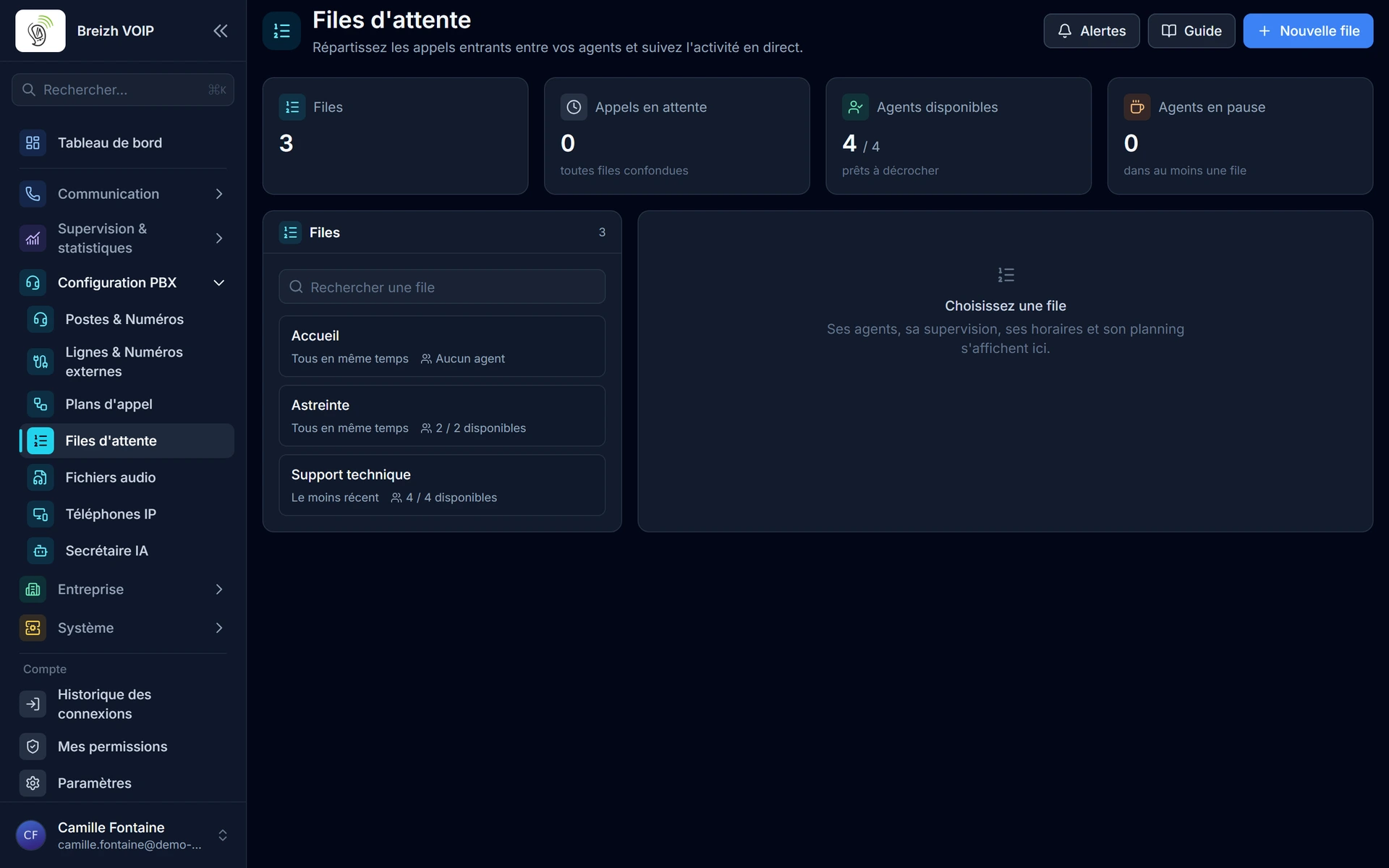
Read the guide: Créer une file d'attente et y affecter des agents
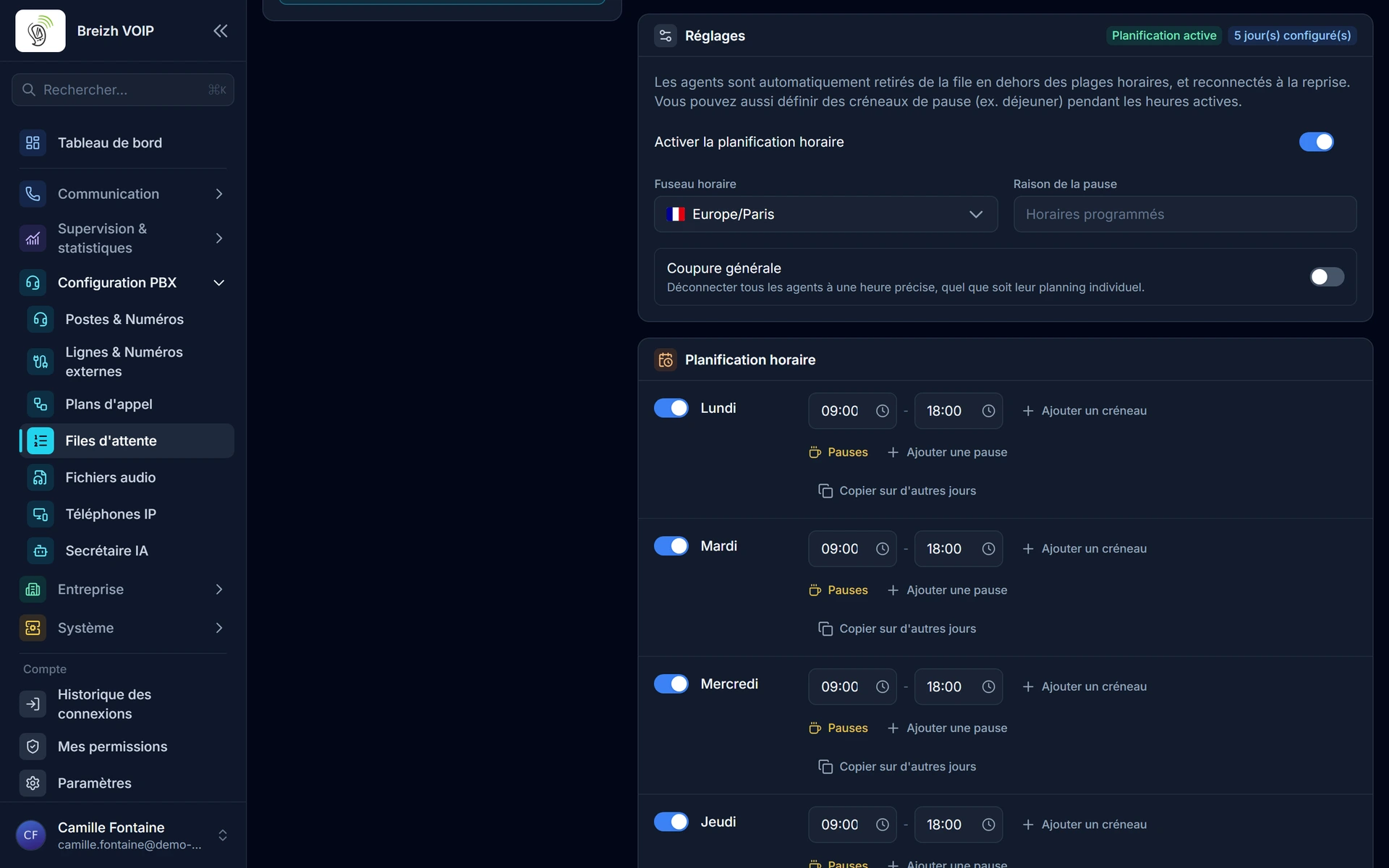
Read the guide: Ouvrir et fermer une file d'attente aux heures de bureau
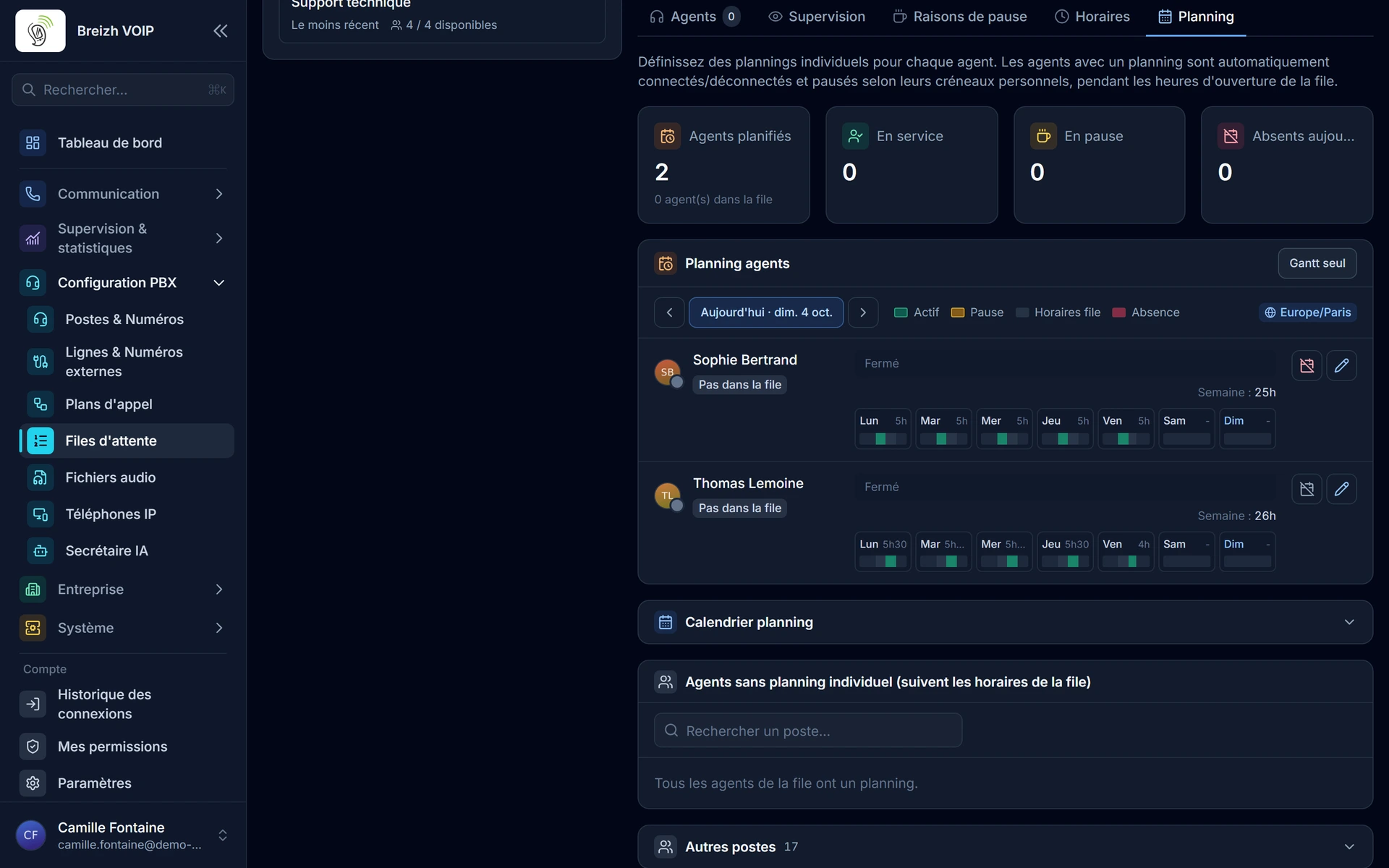
Read the guide: Planifier les horaires de chaque agent d'une file
Related features
Queue supervision
Seeing your queue while it fills, without waiting for the next day's report.
Queue callback
Callers hang up without losing their place. After the delay you choose, the queue offers them to press 1: they confirm their number or…
Real-time supervision
The company's phone activity as it happens. Who is on a call and for how long, which extensions are free, how many calls since this morning.
Use this feature
Tell us what you need and we will put together your quote with you.